
Home › Paul's journeys › First Missionary Journey
Lystra
Zoldera mound near Hatunsaray, Meram, Konya Province, Turkey
In a loud voice Paul called out, “Stand up on your feet!” And the man jumped up and began to walk.Acts 14:10 · Berean Standard Bible
- Date
- c. AD 46–48
- With Paul
- Barnabas
- What happened
- Healing, worship, then stoning
- Modern place
- Zoldera mound near Hatunsaray, Meram, Konya Province, Turkey
The story
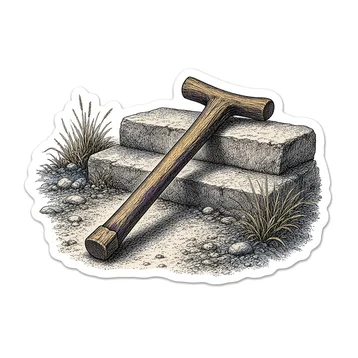
Lystra produced the journey's most dramatic scene. A man lame from birth, who had never walked, sat listening to Paul. Paul looked intently at him, saw that he had faith to be healed, and shouted, "Stand up on your feet!" The man jumped up and walked.
When the crowds saw what Paul had done, they lifted up their voices in the Lycaonian language: “The gods have come down to us in human form!”Acts 14:11
The crowd shouted in their own Lycaonian language that the gods had come down in human form. They called Barnabas Zeus and Paul Hermes, "because he was the chief speaker". The priest of Zeus, whose temple stood just outside the city, brought bulls and garlands to the gates for a sacrifice.
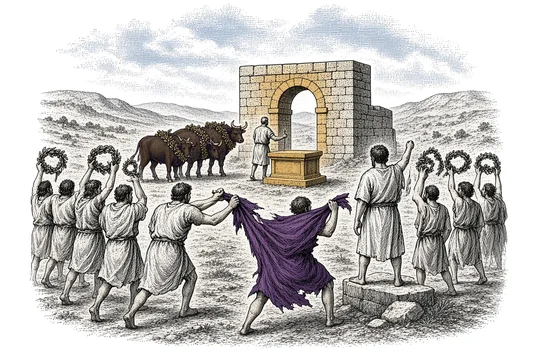

Barnabas and Paul tore their clothes and rushed into the crowd. They insisted they were only human, and urged the people to turn from "worthless things" to the living God who sends rain and harvests. It is Paul's first recorded address to a purely pagan audience, and it does not quote Scripture.
Even so, they could barely stop the sacrifice. Then Jews from Antioch and Iconium arrived and won the crowd over. Paul was stoned, dragged outside the city and left for dead.
Then some Jews arrived from Antioch and Iconium and won over the crowds. They stoned Paul and dragged him outside the city, presuming he was dead.Acts 14:19
When the disciples gathered round him, he got up and went back into the city. The next day he left with Barnabas for Derbe. On his second journey, Paul recruited Timothy here.
They insisted they were only human.
Then and now
In Paul's day
Today
The place in Paul's day
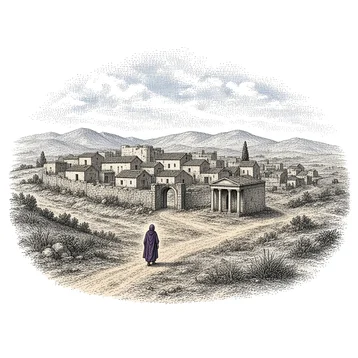
Lystra was a modest market town of Lycaonia set on a mound in a well-watered valley. Augustus made it a Roman colony in 6 BC as Colonia Iulia Felix Gemina Lustra, probably to help control the mountain tribes to the west. It belonged to the province of Galatia and was linked by a Roman road to Iconium. So the town had a Latin-speaking colonial elite while many local people still spoke Lycaonian, a detail Acts preserves. Acts mentions a temple of Zeus "just outside the city" and its priest, but no synagogue. Timothy's mother was Jewish, which shows at least some Jewish presence. Wikipedia notes the town lay on the road from Iconium through Derbe towards the Cilician Gates. No population figure is known.
What you can see today
For most of the 20th century the mound was unexcavated. Ramsay wrote in 1907 that excavation was "urgently needed". Systematic work began only in July 2024, under Assoc. Prof. İlker Mete Mimiroğlu of Necmettin Erbakan University, as part of Türkiye's "Heritage for the Future" programme. Excavators have uncovered a large church thought to be the episcopal church, with four building phases. The first phase was a richly decorated basilica used from the 6th to the 8th century. They have also found Seljuk-period graves, grain-storage jars and Byzantine glazed pottery. The site is an active dig and has few visitor facilities. A small village museum at Hatunsaray displays local finds, and the Lystra inscription is in the Konya Archaeological Museum.
Did you know?
- The town's identity rests on a single stone. The altar Sterrett found names Colonia Iulia Felix Gemina Lustra, and it is on display in Konya.
- In 2025 archaeologists found two Seljuk coins and about 40 burials in a later chapel built in the ruined church. Turquoise clay "evil-eye" beads in two children's graves suggest Christians lived on here under Seljuk rule.
- Lystra seems to have been the first place in Acts where the apostles preached to Gentiles without first going through a synagogue.
How we know where it was
In 1885 J. R. S. Sterrett found at the site a Latin altar inscription naming the Roman colony, Colonia Iulia Felix Gemina Lustra. The stone is now in the Konya Archaeological Museum. Excavations at the site have been under way since 2024.
Uncertain or debated
The identification
The identification at Zoldera/Hatunsaray is very strong but rests mainly on one inscription. Until 2024 the site was unexcavated.
Kilistra
A different site, "Kilistra" near Gökyurt, is sometimes confused with Lystra because of its name. Wikipedia mentions its ruins, but it is not the colony.
Date of Sterrett's discovery
Ferrell Jenkins's blog gives 1855, but Ballance's account (52 years after Arundell's 1833 identification of Antioch) gives 1885. 1885 is correct.
Gods' names
Whether the crowd literally named Zeus and Hermes or Luke used Greek names for local gods is discussed by commentators.
Timothy's hometown
Wikipedia's Derbe article allows either Derbe or Lystra. Acts 16:1 is usually read as Lystra.
Chronology
Wikipedia's Lystra article dates the visit to AD 48. See the chronology note under Antioch.
Bible references
Acts 14:6, 8 (events 14:6–20), 21; 16:1, 2; 2 Timothy 3:11. Lycaonia / Lycaonian: Acts 14:6, 11.