Home › Paul's journeys › First Missionary Journey
Pisidian Antioch
Antioch near Pisidia (Pisidian Antioch; Antiochia Caesarea) · near Yalvaç, Isparta Province, Turkey
For this is what the Lord has commanded us: ‘I have made you a light for the Gentiles, to bring salvation to the ends of the earth.’”Acts 13:47 · Berean Standard Bible
- Date
- c. AD 46–48
- With Paul
- Barnabas
- What happened
- Sermon, crowds, expulsion
- Modern place
- near Yalvaç, Isparta Province, Turkey
The story
This is the longest scene of the journey. On the Sabbath, Paul and his companions went to the synagogue and sat down. After the readings from the Law and the Prophets, the leaders invited them to speak.
Paul stood and addressed "men of Israel and you Gentiles who fear God". He retold Israel's story from the Exodus to King David. Then he announced that God had brought a Saviour, Jesus, from David's line.
Jesus had been condemned in Jerusalem and buried, but God raised him from the dead. Through him, Paul said, forgiveness of sins is proclaimed, and everyone who believes is justified. It is the only full synagogue sermon by Paul that Acts records.
On the following Sabbath, nearly the whole city gathered to hear the word of the Lord.Acts 13:44
Many Jews and converts followed them. The next Sabbath "nearly the whole city" gathered. Some Jewish leaders, jealous of the crowds, contradicted Paul. Paul and Barnabas replied that they would now turn to the Gentiles, quoting Isaiah's "light for the Gentiles". Gentiles rejoiced, and the message spread through the region.
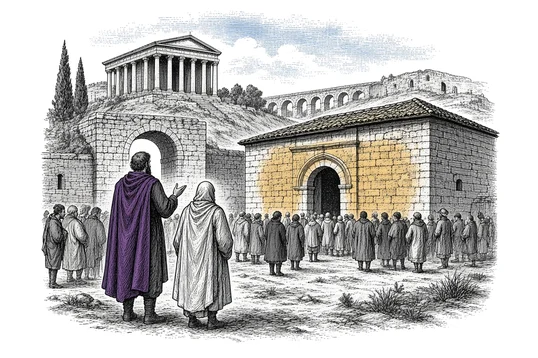

Opponents then stirred up prominent God-fearing women and the city's leading men. The missionaries were expelled from the district, shook the dust off their feet and went on to Iconium. The disciples were "filled with joy and with the Holy Spirit".
So they shook the dust off their feet in protest against them and went to Iconium.Acts 13:51
It is the only full synagogue sermon by Paul that Acts records.
Then and now
In Paul's day
Today
The place in Paul's day
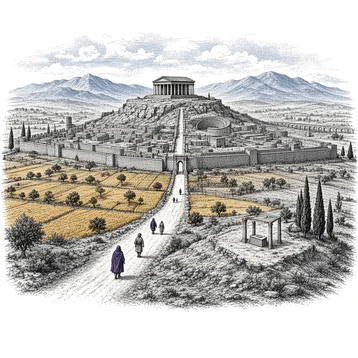
Founded by the Seleucids in the 3rd century BC on the border between Phrygia and Pisidia, Antioch was refounded by Augustus as a Roman colony, "Colonia Caesarea", around 25 BC. It was settled with retired legionaries, and it stood out as the only Pisidian colony given the title Caesarea and Italian legal rights. It belonged to the province of Galatia and served as the hub of the Via Sebaste road system. Latin was the language of its official inscriptions. A temple of Augustus crowned the city above a monumental gateway, and the local moon-god Men Askaenos had a large sanctuary on a nearby hill. Fertile, well-watered land supported farming. Acts shows a Jewish synagogue with Gentile adherents. No reliable population figure survives.
What you can see today
The Antiocheia Archaeological Site is open daily and lies on a hill about 1 km from Yalvaç. A 46-hectare walled area preserves a grid of streets: the Decumanus Maximus running from the triple-arched West Gate, and the Cardo Maximus. Visitors can see the theatre, the rock-cut terrace of the Temple of Augustus with its Propylon, baths, a nymphaeum and long arches of the aqueduct. There is also the 70 × 27 m "Church of St Paul" (Great Basilica). Its mosaics are currently covered with soil for protection. Finds are shown in the nearby Yalvaç Museum, which has a St Paul hall. The ministry website listed the museum as closed when checked in November 2026.
Did you know?
- One of only three surviving copies of Augustus's own record of his achievements, the Res Gestae Divi Augusti, was found here, carved in Latin in front of the temple of Augustus.
- The theatre was enlarged in AD 311–313 right over the main street. The street was carried underneath through a tunnel about 55 m long.
- Inscriptions show that a senatorial family of Sergii Paulli was honoured at Antioch in the later 1st century. That family shares a name with the proconsul Paul had just met at Paphos.
How we know where it was
The site, about 1 km north-east of Yalvaç, was fixed "beyond reasonable doubt" by Francis Arundell in 1833, as M. H. Ballance later put it. Latin inscriptions found there name the Roman colony.
Uncertain or debated
Pisidian or Phrygian?
F. F. Bruce notes that the earliest text of Acts 13:14 means "Pisidian Antioch" in Strabo's sense of "Antioch near Pisidia". The city lay in the Phrygian region of the province of Galatia, and the later reading "Antioch of Pisidia" reflects 4th-century provincial boundaries. Modern atlases use both labels.
South vs North Galatia
If Paul's "churches of Galatia" (Galatians 1:2) were these southern cities (Antioch, Iconium, Lystra, Derbe), the "South Galatian" view holds. The "North Galatian" view places them among ethnic Galatians around Ancyra. Both views have serious defenders.
The Sergii Paulli
William Ramsay suggested these local Sergii Paulli were relatives of the Cyprus proconsul, and that this explains why Paul went to Antioch next. Ramsay himself called this a hypothesis, and van Elderen and others have rejected it as speculative.
The synagogue site
Ramsay thought an earlier apse under the Great Basilica overlay the synagogue where Paul preached. This is unproven, and the church's phases are unclear.
"Yalvaç"
Wikipedia suggests the town's name means "prophet", perhaps a memory of Paul. This is speculative.
Bible references
Acts 13:14 (events 13:14–52); 14:19, 21; 2 Timothy 3:11. Pisidia: Acts 13:14; 14:24. (Other "Antioch" references are to Syrian Antioch.)