Home › Paul's journeys › First Missionary Journey
Perga
Perga (Perge) · Aksu, Antalya Province, Turkey
After setting sail from Paphos, Paul and his companions came to Perga in Pamphylia, where John left them to return to Jerusalem.Acts 13:13 · Berean Standard Bible
- Date
- c. AD 46–48
- With Paul
- Barnabas; John Mark until he left here
- What happened
- John Mark goes home
- Modern place
- Aksu, Antalya Province, Turkey
The story
The ship from Paphos brought Paul's party to the south coast of Asia Minor, and they came to Perga in Pamphylia. Acts records only one event on this first visit: John Mark left them and returned to Jerusalem. Luke gives no reason.
The sequel shows how much it mattered. When planning the second journey, Paul refused to take Mark "because he had deserted them in Pamphylia". The disagreement was sharp enough that Barnabas and Paul separated. Years later Paul's letters speak warmly of Mark again.
But Paul thought it best not to take him, because he had deserted them in Pamphylia and had not accompanied them in the work.Acts 15:38
Acts mentions no preaching in Perga at this stage. The party headed inland to Pisidian Antioch, climbing through the Taurus Mountains, probably along or near the Roman roads Augustus had built.
And from Perga, they traveled inland to Pisidian Antioch, where they entered the synagogue on the Sabbath and sat down.Acts 13:14
Why they moved inland so quickly is not explained. Paul later told the Galatians he first preached to them "because of an illness". Some scholars connect this with the hurried move, but the text never does.
On the way home they stopped at Perga again, and this time they did preach there.
Why they went so quickly inland is not explained.
Then and now
In Paul's day
Today
The place in Paul's day
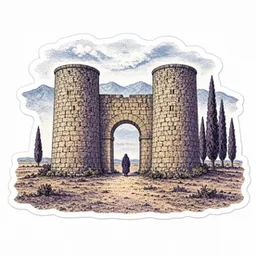
Perga was one of the leading cities of Pamphylia, competing with Side for first place. It lay on the coastal plain about 11 km from the mouth of the Cestrus river. Rome had controlled the area since 133 BC. Perga's Hellenistic walls and its iconic pair of round gate towers dated from the 3rd century BC, and its patron goddess, "Artemis of Perga", was famous across the region. Under Claudius (AD 41–54), the emperor when Paul came, the city was building a palaestra. Most of the splendid buildings seen today, including the long colonnaded street with its water channel, the nymphaea, the theatre and the stadium, are later, from the 2nd–3rd centuries. No reliable population figure survives.
What you can see today
Perge Archaeological Site is about 18 km east of Antalya at Aksu. It is open daily (hours vary by season; check muze.gov.tr) and is on Türkiye's UNESCO Tentative List. Visitors enter past the Roman gate and the two round Hellenistic towers, symbols of the city, then walk the colonnaded main street with its central water channel to the nymphaeum. The stadium, which held about 12,000 people, is one of the best preserved from antiquity. There are also the agora, baths and theatre. Much of Perge's fine sculpture is now displayed in the Antalya Museum. The ministry notes that the St Paul Trail long-distance walking route starts here.
Did you know?
- Perga was the birthplace of Apollonius of Perga, the Greek mathematician known for his work on conic sections.
- The temple of Artemis of Perga, the city's famous goddess, has never been securely located. Coins show both the goddess and her sanctuary.
- Hittite records from Hattusa (a 13th-century BC bronze treaty tablet) probably refer to the city as "Parha".
How we know where it was
The ruins near Aksu have been systematically excavated by Istanbul University since 1946. Inscriptions and coins name the city, and the site matches ancient descriptions of Perga on the Cestrus (Aksu) river.
Uncertain or debated
Why John Mark left
Acts gives no reason, and all suggestions are speculation.
Paul's illness
The theory that Paul fell ill on the coast and headed for the highlands to recover connects Galatians 4:13 with this verse. It is a hypothesis, not stated in the text.
Where they landed
It is not said whether the ship came up the Cestrus towards Perga or landed at Attalia and went on by road.
Which "Perga" Paul saw
Much of the visible city post-dates Paul. Even so, it is reasonable to picture the Hellenistic gate towers, which date from the 3rd century BC.
Provincial status
Pamphylia's status in the 40s is not straightforward. The UNESCO Tentative List text mentions a 1st-century federal Lycia–Pamphylia arrangement, and the details and dates are discussed by specialists.
Bible references
Acts 13:13, 14; 14:25. Pamphylia, its region: Acts 2:10; 13:13; 14:24; 15:38; 27:5.